
Daily Mirror: 20 November 2025 12:00 am
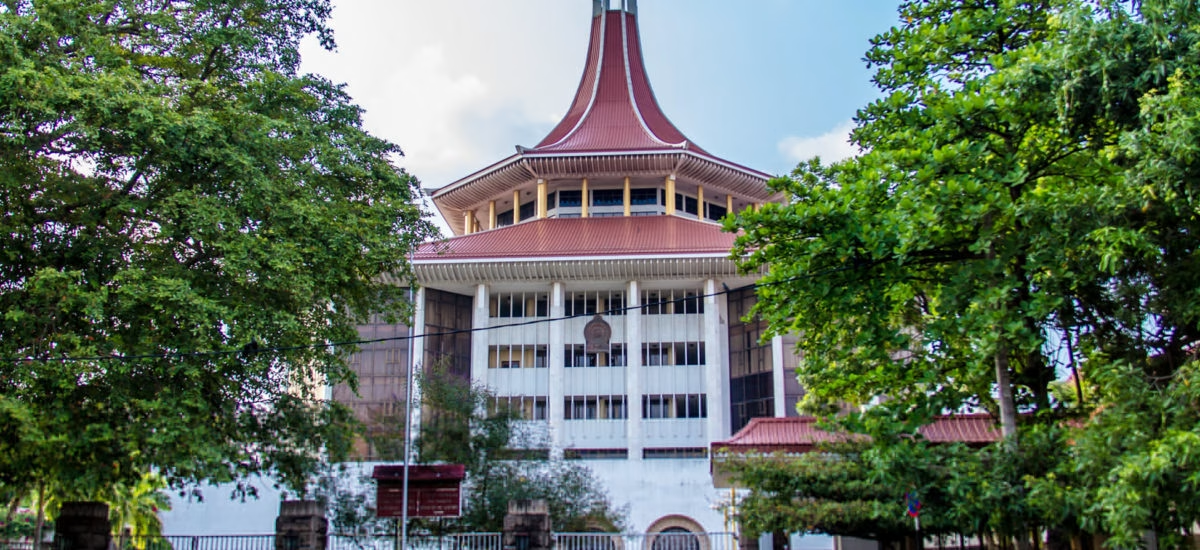
The Supreme Court has condemned ragging as ‘shameful and unacceptable’ following the death of student Charith Dilshan at Sabaragamuwa University. File Photo
In a powerful demonstration of judicial oversight, the Supreme Court took decisive action to confront the persistent problem of ragging in Sri Lankan universities, following the tragic suicide of Charith Dilshan, a Sabaragamuwa University student, who ended his life in April 2025 after enduring alleged severe physical and sexual abuse.
Two cases, filed by the President and Secretary of the Bar Association of Sri Lanka (BASL) and another by Charith’s parents with the legal support of Rage, a civic organisation providing pro bono assistance to students subjected to ragging and harassment, were heard before the Supreme Court bench comprising Justice Yasantha Kodagoda, PC, and Justice Janak De Silva. Representing the BASL, counsel Senany Dayaratne, highlighted the systemic failures that allowed ragging to persist unchecked, citing an independent committee report that documented the incident in detail and identified those responsible.
Appearing for the parents, senior counsel Avindra Rodrigo, PC, emphasised that despite the Ragging Act of 1998 and repeated orientation and awareness programmes, enforcement has largely been symbolic. He pressed the Court on the lack of meaningful action by universities and the University Grants Commission (UGC). He asked what additional steps, beyond the decade-old practices, had been taken since Charith’s death to prevent such a tragedy from happening again.
Subsequently the Supreme Court bench questioned counsel representing the Vice Chancellor, the Dean, and the Attorney General to account for measures taken following Charith’s death. The Court also examined whether the directives in its earlier order in SC/FR/216/20, which had formulated anti-ragging guidelines, had been implemented. It was revealed that the guidelines had not been formally adopted. While the UGC had convened meetings and appointed anti-ragging officers prior to Charith’s death, Sabaragamuwa University had even failed to participate, and key measures remained unimplemented across other institutions.
Having heard all parties, the Supreme Court granted leave to proceed to two rights petitions filed by the BASL and family of the ragging victim of Sabaragamuwa University. In a firm intervention, the Justices also condemned ragging as a shameful and unacceptable practice and issued several interim orders.
For the President and Secretary of the Bar Association of Sri Lanka, Petitioners in SC/FR/101/2025, Senany Dayaratne with Sankhitha Gunaratne, Harith De Mel, Nishadi Wickramasinghe, Rachika Palihawadana, Susitha Dangahadeniya, Gangulali Dayarathna, Minul Muhandiramge, Janani Abeywickrama, and Maheshika Bandara instructed by Senior Instructing Attorney-at-law GG Arulpragasam appeared.
For the parents of Charith Dilshan, Petitioners in SC/FR/147/2025, Avindra Rodrigo PC, with Tharushi Jayaratne, Yasue Karunaratne, and Praveen De Silva appeared on the instructions of the Human Rights Law Chambers.
Leave a Reply