
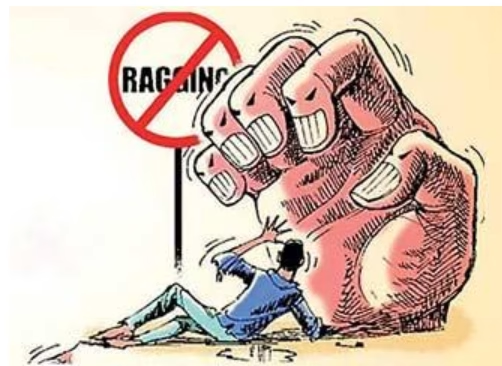
Daily Mirror: 05 May 2025
An aspiring IT expert no more
Charith Dilshan (23) from Ihalagama, Gampola had his primary education at Gampola Buddhist College. After passing his O/Ls he had pursued A/Ls at the Peradeniya Central College, upon which he was selected to the Technology Faculty of the Sabaragamuwa University. Dilshan had been interested in pursuing a career in the IT field and had even developed his own graphics venture by the name Charith Graphics.
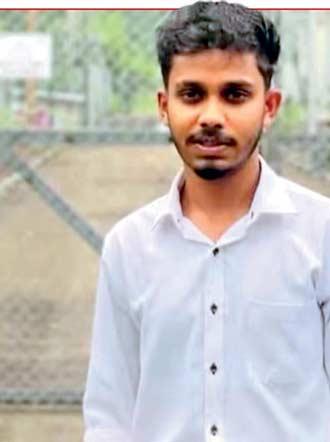 A photo of young Charith Dilshan A photo of young Charith Dilshan |
“He designed a sticker with the title ‘Charith Graphics’ and pasted it in his room. He used to design posters for various events and would even show us,” said one of Charith’s uncles who spoke to the Daily Mirror on conditions of anonymity. “Several days prior to this incident he called me and said that he would do a video of mine and that he would complete it once he returns for the holidays. But he left us,” the family member said.
Following his death, a letter that was being circulated indicated that he had been suffering from depression for a while. But the family member claimed it to be a false claim because it was Dilshan who coordinated lessons to the rest of the students in his batch and in fact had had a cordial relationship with staff and the administration. “We all know the suffering he had to endure prior to his death. If not for his batch mates, who also underwent a similar rag on the day of the incident, who later lodged a complaint in Police, this incident would have been swept under the carpet. Already there are attempts to dismiss the fact that this incident took place as a result of ragging,” he said.
 The Daily Mirror learned that Dilshan’s mother is finding it difficult to cope with the tragic passing away of her elder son. The family member further said that Dilshan has a little brother and his father is not expressing his grief until the bana (Religious sermon) and alms giving concludes. “We are getting ready for bana today (Sunday) and the entire village is in shock. Dilshan had a purpose to live and it is wrong to say that he had given up on life. We urge the authorities to remove the word ragging as well as this culture if justice needs to be served for our beloved son’s death. Then at least he would be remembered for putting an end to this brutal crime rather than being remembered as someone who took his life as a result of depression or some other psychological issue. As a family we will continue our fight to seek justice for our son,” he underscored.
A brutal kind of bonding
The consequences of ragging are manifold. In fact, there are individuals who dislike universities for the rest of their lives, because their parents passed away after seeing and hearing what their children endured. There are instances where undergraduates suffered lifelong trauma and there are some who ended their university careers half way through the course. Ragging is also known as ‘bonding’ or ‘socialising’ much to the trauma of students who come from rural areas. The Daily Mirror learns that despite university marshals handing out leaflets on the Anti-Ragging Act and debriefing freshers during their orientation programmes, seniors would still find an opportunity to brainwash them. The seniors (often called sinno in university language) would get hold of freshers and brainwash them to believe that the marshals are in fact untrustworthy people and that they flirt with female students and eventually end up in relationships. By instilling this fear psychosis among freshers, the seniors earn their trust and respect as the former feel isolated and would doubt the credibility of marshals. This way the seniors slowly convince freshers to carry out their tasks and they fall prey to ragging. Thereafter they have no way out.
Protecting victims and witnesses of ragging
The Victim and Witness Protection Act of 2023 provides legal protection for victims and witnesses and there’s an authority established as well. The Daily Mirror learned that over 20 other students, who were Dilshan’s batch mates had to endure ragging around the same period. “They were asked to give their testimonies to the Police on May 2,” said attorney-at-law Rachika Palihawadana the lawyer who appeared on behalf of them. “So when they went to the Police there were some media personnel as well. One of them had obtained videos of these students and sent it to his channel. However these students were labeled as suspects of the Sabaragamuwa University incident. Many of their identities were revealed. Thereafter we had to intervene to request the media channel to take down the content. Some social media users had already threatened these students. We obtained their ID numbers and addresses and informed the police stations in respective areas because their safety became a concern for us,” he added.
He further said that university ragging shouldn’t be entertained under any circumstance but it cannot be eradicated at once. “It has been inculcated in the university culture for a long time. But we are working to ensure that this would be the final suicide incident of a university student that happened following a rag” he underscored.
Zero tolerance on ragging, the need of the hour
Dilshan in fact is not the first student who committed suicide following a ragging incident. Even though university academics said that a zero tolerance policy on ragging should established, such proposals have never seen light of day. Echoing similar sentiments, Professor of English, University of Peradeniya Arjuna Parakrama said that many academics have long maintained that there should be zero tolerance for ragging. “In the University of Colombo when I was the Dean at the Faculty of Arts, we actually took some steps to stop ragging and it was diminished as a result, but zero tolerance is necessary. The problem is that there is a kind of hypocrisy about ragging, partly because it served a political function; in the sense that you get students who are then coerced into participating in various things and authorities turn a blind eye to that,” he said.
Prof. Parakrama reiterated that there should be zero tolerance on any form of ragging. He said that he objects to people who say certain kinds of ragging is fine. “The fact of the matter is that even the consent is coerced. In residential universities, access to the hostel is determined by the acceptance by the student’s body and that has to do with allowing students to be ragged. There should be no question about gradation, that some ragging is fine and some is not. Some are cultural, some social and all kinds of rubbish. The consequences of ragging are differential. If someone is shy and doesn’t like to be engaged in these kinds of activities then it would be traumatic. Even being forced to sing a song could be traumatic. We have no right or students or anybody has no right to say that it is acceptable. It has to be a principle and not a contingent thing based on practices and so on,” he explained.
Fostering an anti-intellectual society
“Secondly, what it engenders is a brutalised, anti-intellectual society,” Prof. Parakrama continued. The university should be an exemplary place, way beyond the social norms. It should be more progressive, more forward looking, more open and free than other places. So I don’t subscribe to the notion that the university is a microcosm of society. It should not be. It’s the cream of the students who have performed well in schools and are nurtured in a particular kind of way. It should be an example of concern, sensitivity in terms of gender, ethnicity, dissent and so on. But that is not there at all. What we have nurtured are other outcomes – the direct outcomes of ragging such as brutalization, humiliation and so on which is terrible. It also fosters values of conformity, mindlessness, disobedience and of a very violent, anti-intellectual culture,” he said.
He further said that after a student is ragged they wait till others tell them what to do, they are not creative, they don’t think independently and they are not critical. It conforms to a kind of dominance. “Once dominance is imposed you don’t have to worry because they are already susceptible to that dominant thinking. You won’t get ragging if the intellectual culture in the university was healthy. The values are all primitive, hierarchical and male-dominated. There is also a trend where Muslim students rag Muslim students, plantation Tamil students rag their counterparts and so on. Those hierarchies, divisions are maintained and the rag is the most conservative kind of approach in that sense,” he explained.
Prof. Parakrama claimed that most lecturers and university administrations strike deals with the student leadership and the student leadership allows some students to engage in ragging because then they get a pliant, servile group of students that they could manipulate. “Administrators like it because they negotiate with student leaders and turn a blind eye. When they go to their second or third years another set of students are being nurtured to become pliant and called to do various activities,” he added.
Legitimising the rag as a subculture
While the Anti-Ragging Act No. 20 of 1998 is a draconian and loosely defined piece of legislation, it leaves room for more ugly forms of ragging to traumatise future generations of this country. “Now there’s an ugly trend where ragging is invoked in second or third year and it’s not a limited thing anymore. It is then couched in awful bullshit notions saying it’s a subculture and this is quite atrocious. People who have strange sexual and other predilections use the rag to legitimise those perverse attitudes. They get titillated and a masochistic experience which they won’t get under normal circumstances. It legitimises all those deviations pretending that it is part of the subculture,” he explained further. He further said that ragging perpetuates violence and violence perpetuates ragging and that there are no normal democratic practices that you have in normal universities. “There is no dissent, no forward thinking, no space for discussion in reality and universities are more backward than ordinary society,” he stressed.
The Daily Mirror learned that it is mostly students from rural areas who are ragged, tormented and brutalised and that ragging coincides often with English courses at the beginning of the university. Speaking about students who are more vulnerable of being ragged, Prof. Parakrama said that students who need English badly won’t be able to learn it because that’s the time they are being ragged the most. Students who have some knowledge of English tend to be anti-raggers and they are the least affected by ragging. So it reinforces hierarchies that it pretend that it’s trying to break. Then there are others who have to get the rag otherwise they don’t get a place in the hostel,” he said.
Prof. Parakrama said that ragging thrives because the university is a very barren and anti-intellectual kind of place. He claimed that following the recent incident, none of the unions have said that we should stop it. “They say they have to ‘check’ whether it happened due to ragging, ‘whether the student had some psychological issue’ and so on. The student leadership allows these freak students who need psychological attention to do what they want because in return they get the puppets to do what they want to do,” he said while adding that student unions need to be honest.
RAGE.LK offers free legal support for victims of ragging
Due to mounting cases of ragging, a group of lawyers have come forward to offer free legal support for students, families and friends. “As much as I’m disgusted and heartbroken by this tragedy, disgust alone won’t bring justice. We need action,” underscored Co-founder of RAGE.LK Yasu-e Karunaratne. She further said that they are looking at conducting awareness sessions within the university community. “We are also awaiting responses from institutions responsible for student safety, including the University administration and the University Grants Commission (UGC). We hope they will clearly communicate their next steps and let us know how civil society groups like ours can contribute meaningfully to preventing such tragedies in the future,” she added. She further urged students and parents who may have information about this incident to safeguard any evidence (messages, recordings, written complaints) before it is lost or destroyed. “Too often, perpetrators of ragging walk free due to lack of documentation,” she said.
If you are victim of ragging or know someone who needs support due to such traumatic experiences you could reach out to RAGE.LK on rage.srilanka@gmail.com or via their social media accounts –
Instagram: @rage._lk
Facebook: Ragedotlk
The following helplines are available for those who are struggling with mental health issues and need assistance. You are not alone.
Leave a Reply